Best Places to Visit in Petra (2026 Travel Guide)
Petra is one of the greatest archaeological wonders of the world. Discover the best places to visit in Jordan's Rose City in 2026 — ancient temples, royal tombs, and a landscape that takes your breath away.
Best Places to Visit in Petra (2026 Travel Guide)
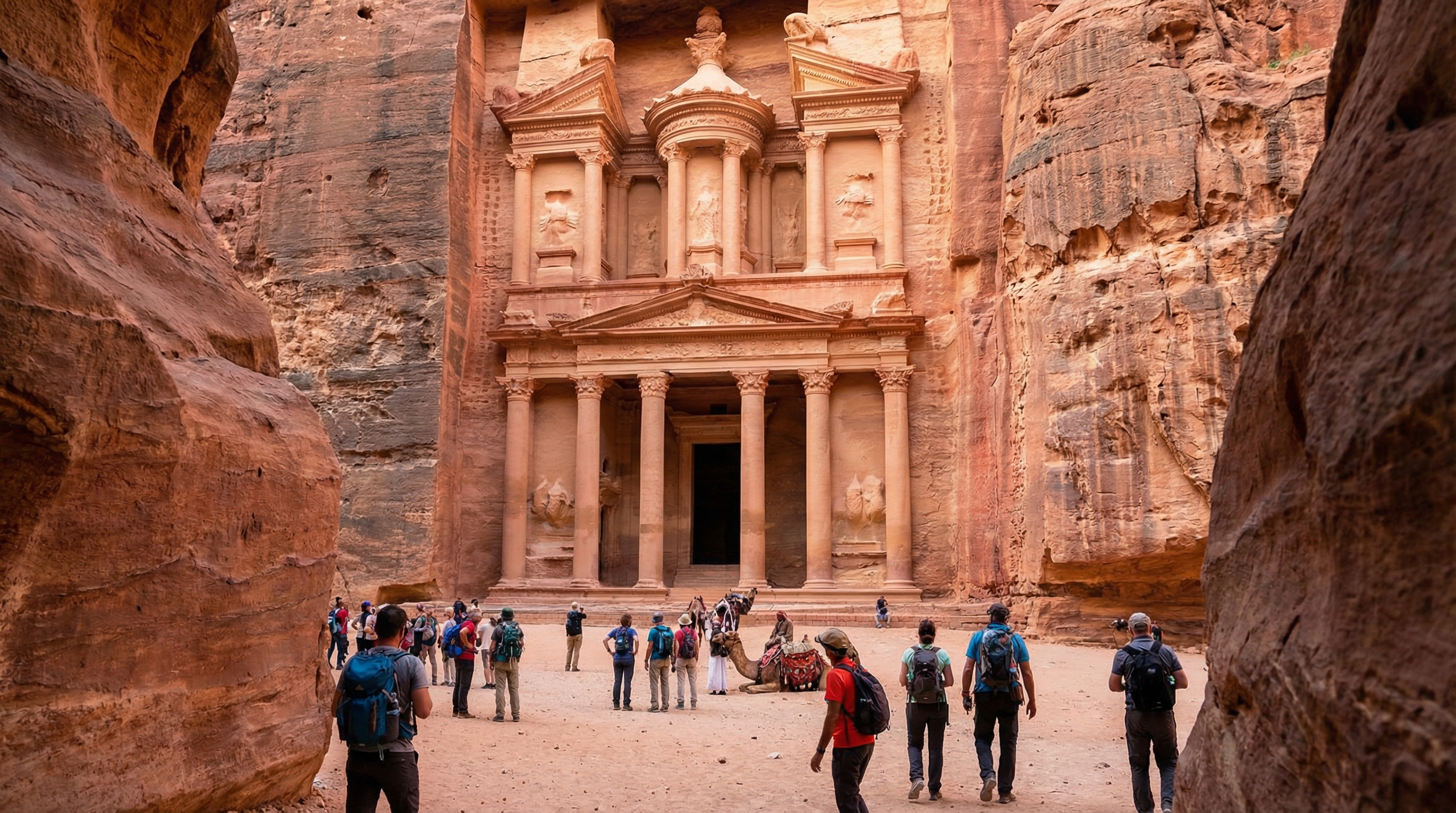
Hidden behind a narrow canyon in the red desert mountains of southern Jordan, Petra is one of those rare places that can genuinely leave you speechless. The ancient Nabataean capital — carved directly from rose-red sandstone cliffs over 2,000 years ago — is a UNESCO World Heritage Site and one of the New Seven Wonders of the World. No photograph, no matter how stunning, truly prepares you for the moment the canyon opens up and the Treasury appears before you. This is Petra's greatest gift: the experience of discovery.

1. The Siq – The Dramatic Canyon Entrance
The Siq is the 1.2-kilometer narrow gorge that forms Petra's main entrance — a natural crack in the sandstone mountains that narrows in places to just a few meters wide. As you walk deeper into the canyon, the walls rise to 80 meters on either side, their layers of red, pink, and purple rock telling 500 million years of geological history. Ancient Nabataean water channels are still carved into the walls. The anticipation builds with every step — and then the Siq curves one final time, and the Treasury appears.
2. Al-Khazneh – The Treasury
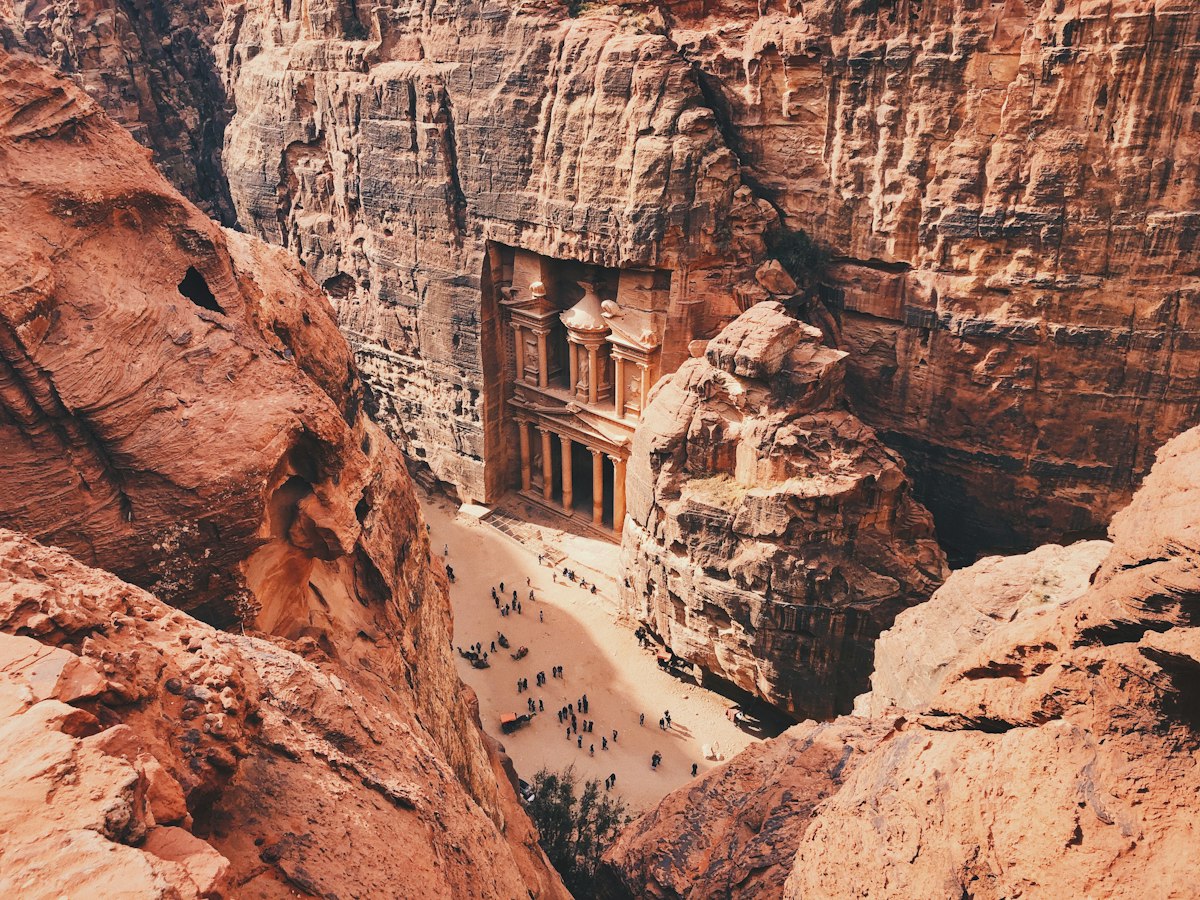
The Treasury (Al-Khazneh) is Petra's most iconic monument — a 40-meter-high facade of extraordinary classical architecture carved directly into a sheer sandstone cliff. Despite its name, it was never a treasury but rather the elaborately decorated tomb of a Nabataean king, built around the 1st century BC. In the morning light, when the rose-colored rock glows warmly and the shadows play across the carved columns, it is one of the most magnificent sights in the world.
3. The Street of Facades and Royal Tombs
Beyond the Treasury, the main canyon of Petra opens up to reveal the Street of Facades — a long cliff face carved with dozens of tomb entrances in a remarkable variety of styles. Further on, the Royal Tombs are the most impressive: the Urn Tomb with its vast open terrace, the Silk Tomb whose swirling rock colors defy description, and the Palace Tomb with its enormous five-level facade. Walking this street is like wandering through the pages of a civilization's history carved in rock.
4. The Colonnaded Street and the Great Temple
At the heart of ancient Petra lies the Colonnaded Street — the city's main commercial thoroughfare in Nabataean times. Original column bases still line the path, and the foundations of shops, temples, and public buildings stretch on either side. The Great Temple complex nearby is the most extensively excavated site in Petra and reveals the sophisticated urban planning of a civilization that controlled the spice and incense trade routes of the ancient world.
5. The Monastery – Petra's Grandest Monument
The Monastery (Ad Deir) is even larger than the Treasury — its facade stands 45 meters wide and 50 meters tall — but reaching it requires climbing 800 rock-cut steps into the mountains above the main site. The climb takes 45–60 minutes and passes viewpoints, cave cafés, and Bedouin vendors. The reward is immense: the Monastery in relative solitude, with the Jordanian highlands stretching to the horizon behind it.
6. Petra by Night – Candlelight in the Siq
Three nights a week, Petra transforms into something magical. Hundreds of candles light the path through the Siq to the Treasury, which glows in the candlelight while Bedouin musicians play traditional music. It is a deeply atmospheric experience — one of the most memorable evenings in travel.
Travel Tips for Visiting Petra
- Start as early as possible — 6 AM when the site opens. The Treasury in morning light is extraordinary and the crowds have not yet arrived.
- Allow at least two days to do Petra justice. One day is never enough.
- Wear comfortable, closed-toe shoes — the terrain is rocky and uneven throughout.
- Carry plenty of water and snacks. The site is vast and the sun is intense.
- The Jordan Pass (purchased online) includes the visa fee and Petra entry — essential for most visitors.
FAQ
How many days should you spend in Petra?
Two days is the minimum to explore Petra meaningfully. Day one covers the main route from the Siq to the Treasury, the Royal Tombs, and the Colonnaded Street. Day two allows for the Monastery hike and the High Place of Sacrifice trail.
Is Jordan safe for tourists?
Jordan is consistently one of the safest countries in the Middle East for tourists. The Jordanian people are renowned for their hospitality, and Petra and Wadi Rum are well-organized, established tourist destinations with excellent infrastructure.
What else can you see near Petra?
Wadi Rum — the spectacular desert made famous by Lawrence of Arabia — is just 90 minutes away and a perfect companion to a Petra visit. The Dead Sea and Amman are also within comfortable day-trip or overnight distance.
Conclusion
Petra is one of those rare places that reminds you why travel matters. The sense of discovery as the Treasury reveals itself at the end of the Siq, the silence of the Royal Tombs at dawn, the view from the Monastery at the edge of the world — these are experiences that connect you to something ancient, something human, and something timeless. Petra does not just impress. It moves you.